




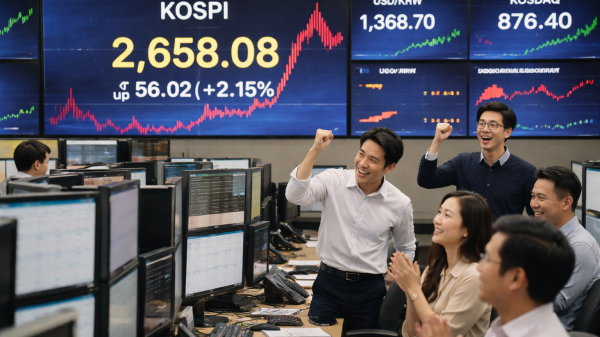


A company that just posted the largest quarterly operating profit in the history of the technology industry should not see its stock fall 7% — unless the market believes the profit itself is the top. Samsung Electronics (KRX: 005930) reported preliminary second-quarter 2026 operating profit of ₩89.4 trillion ($58.4 billion) on July 7 — up roughly 19-fold from a year earlier, 6.2% above the ₩84.16 trillion consensus, and enough to overtake Nvidia’s record $53.5 billion quarter and Apple’s all-time peak (KED Global). The shares answered by falling as much as 10% intraday and closing 6.9% lower near ₩291,500 (Benzinga). This Samsung price prediction maps the ₩600,000 bull case, the ₩390,000 bear case, and the single question that separates them: is a memory supercycle earnings peak a sell signal, or is this cycle built differently?
The angle the record-profit headlines miss is the valuation inversion it exposes. Samsung just out-earned Nvidia in absolute operating profit — yet after the selloff it trades near 5 times forward earnings by Benzinga’s math, while Nvidia commands 21.7 times. The market is paying roughly four times more per earnings dollar for the company that designs AI chips than for the company that just made more money supplying the memory those chips cannot run without. That gap is not an oversight; it is a priced conviction that memory earnings mean-revert violently while GPU earnings compound. Every won of the ₩390,000–600,000 target spread securities firms now carry is a position on whether that conviction survives this cycle — and the strongest counterargument comes from the cycle’s own structure, not from hope.
Key Facts:
• Q2 2026 preliminary operating profit: ₩89.4 trillion ($58.4 billion), up ~1,810% year on year — the largest quarterly operating profit ever reported by a major tech company — The Korea Herald, July 7, 2026 • The result tops Nvidia’s record $53.5 billion operating income for its quarter ended April 26, 2026 — Korea Herald • Revenue jumped 129.3% year on year to a record ₩171 trillion; the beat vs consensus was 6.2% — Yonhap Infomax via Korea Herald • The stock fell up to 10% intraday on July 7 and closed 6.9% lower, near ₩291,500, after a ~150% year-to-date run — Benzinga • Securities-firm targets now span ₩390,000 to ₩600,000; all 18 post-earnings reports kept Buy or Strong Buy — BigGo Finance • IBK Investment & Securities raised its target 31% to ₩460,000; Eugene Investment & Securities holds ₩560,000 — BigGo Finance, July 8, 2026 • Analysts estimate the memory division alone generated operating profit in the ₩90 trillion range on surging DRAM and NAND prices — Korea Herald
What’s actually happening: memory became the profit centre of the AI boom
The mechanics of the quarter are brutally simple: AI data centres consume high-bandwidth memory (HBM) and conventional DRAM faster than the three companies capable of making them — Samsung, SK Hynix and Micron — can expand supply, and pricing has responded the way commodity pricing does when demand goes vertical. Samsung’s memory division is estimated to have produced roughly ₩90 trillion of operating profit on its own, meaning the memory business effectively *is* the record. Commercial HBM4 shipments began during the quarter, with volumes ramping in earnest from Q3, and all three HBM4 suppliers are qualified for Nvidia’s Vera Rubin platform — the same demand engine we mapped from the buyer’s side in our Nvidia price prediction published this morning.
The stock’s reaction is the textbook problem of a 456% rally off the 52-week low of ₩60,200: by July 7, a blockbuster was already in the price. Analysts were explicit that the near-150% year-to-date run-up left the beat “with little power to push the stock higher”, and the print instead triggered profit-taking that spread across the entire memory complex — Micron, SanDisk and Western Digital sank about 7% the same session (24/7 Wall St). The bull-bear split among covering analysts crystallised immediately. Kim Sun-woo of Meritz Securities argues this is a structurally different cycle: with demand having shifted from consumer devices to Big Tech’s AI infrastructure spending, he contends the cycle will not turn until competitors stop investing — a point he projects as “2-3 years away at the earliest” (Seoul Economic Daily).
Quick Take: Record profit, falling stock, unanimous Buy ratings, and a ₩210,000-wide target spread — Samsung is now a referendum on whether AI memory is a commodity cycle or a new baseline.
The industry response: rivals validate the cycle by spending into it
Watch what the competitors do, not what the sell side says. SK Hynix and Samsung have jointly pledged roughly $2 trillion in capacity investment to address the memory shortage — the figure that anchors the bear case for pricing in 2027 and beyond, as we detailed in our Micron $385–$2,000 scenario analysis. Micron’s 2026 HBM output is already sold out under multi-year contracts, and its fiscal Q3 revenue of roughly $41.5 billion at an 85% non-GAAP gross margin shows what the pricing environment is doing for every player in the oligopoly. By Kim Sun-woo’s own framework, this capex race is the cycle’s fuel — it turns when someone blinks, and no one is blinking.
The buyers are hedging in the other direction. Hyperscalers facing memory-driven cost inflation — the same capex arithmetic that dragged Meta below its own bear-case target, covered in our Meta price prediction — are signing multi-year supply agreements and taking strategic stakes in the pipeline; Anthropic’s latest funding framework explicitly integrates Samsung, Micron and SK Hynix as prioritised memory partners. Institutional voices, meanwhile, frame the selloff as positioning rather than thesis change: analysts at UBS and Bank of America characterised the pullback as a “healthy reset” within a memory supercycle rather than a structural break (Seoul Economic Daily, July 9, 2026).
Market impact and the numbers: ₩600K bull vs ₩390K bear
The post-earnings target board is unusually wide for a stock every covering firm rates a Buy — which is itself information: nobody disputes direction, only duration and multiple.
| Scenario | Target | What has to happen | Key evidence for | Key evidence against |
|---|---|---|---|---|
| Bull — ₩600,000 | Top of the securities-firm range (Eugene at ₩560,000, high prints to ₩600,000) | HBM4 ramps through H2 at premium pricing; DRAM/NAND stay tight into 2027; the market re-rates memory earnings as structural | Memory division alone earned ~₩90T; HBM4 qualified for Vera Rubin; Meritz sees no cycle turn for 2–3 years | Requires paying a multiple memory has never sustained through a downcycle |
| Base — ₩460,000 | IBK’s raised target; consensus means ₩426,000–468,000 | Full Q2 results (due late July) confirm the preliminary print; Q3 guidance holds pricing momentum | 18 of 18 post-print reports Buy/Strong Buy; ~5x forward earnings leaves re-rating headroom | ~150% YTD run already banked much of it |
| Bear — ₩390,000 | Bottom of the post-earnings target range | The $2T capacity wave lands into decelerating AI capex; DRAM pricing rolls in 2027; the peak-earnings sell signal proves right | Stock fell 7% on the best print in tech history — the tape is already sceptical; memory peers entered a bear market the same day | Even this “bear” sits ~34% above the ₩291,500 post-selloff price |
Sources: BigGo Finance (July 8, 2026), Benzinga, Korea Herald, Seoul Economic Daily; compiled July 9, 2026.
The synthesis worth pricing mirrors the one we ran on Meta this morning, inverted: Samsung’s *bear-case* target of ₩390,000 sits roughly 34% above the post-selloff price of ₩291,500, just as Meta trades below its Street bear case — the market has once again done the de-rating before the analysts did. And pair it with Nvidia: if memory pricing holds long enough for Samsung to earn ₩89 trillion again in Q3, Nvidia’s input costs rise while Samsung’s multiple has the most room to expand of any AI-complex mega cap. At ~5x forward earnings versus Nvidia’s 21.7x, the trade the market is offering is the same one it offered with Meta: bull-case fundamentals priced with bear-case arithmetic. The difference — and it is the whole risk — is that memory earnings have collapsed from record peaks before, and the history is quantified: after the 2018 super-cycle peak, Samsung’s full-year operating profit fell from ₩58.9 trillion to ₩27.8 trillion in a single year as DRAM pricing normalised, a 53% collapse from what was then also a record (company disclosures). The 2022 downcycle repeated the shape. What the bulls are really arguing is that HBM changes the arithmetic: unlike commodity DRAM, high-bandwidth memory is sold increasingly under multi-year qualified contracts tied to specific GPU platforms — Vera Rubin today — which dampens the spot-price whiplash that produced those earlier halvings. Whether HBM is a big enough share of the ₩90 trillion memory result to matter is exactly what the late-July divisional breakdown will reveal.
Quick Take: Even the post-earnings bear target is a third above the market. The bears aren’t in the research notes — they’re in the order flow.
The regulatory tension: an oligopoly earning record profits attracts lawyers
Record profits from a three-firm market invite exactly the scrutiny that arrived two weeks before the print: on June 25, Samsung, SK Hynix and Micron were sued in US federal court in a class action alleging collusion and price-fixing in the commodity memory market. The industry has been here before — the 2000s DRAM price-fixing cases ended in guilty pleas and hundreds of millions in fines — and a 1,810% profit surge across a concentrated market is the kind of exhibit plaintiffs dream about, whatever the eventual merits. Layer on the geopolitical stack: US export controls constrain what the Korean makers can ship to and produce in China, Washington’s CHIPS-era incentives tie expansion decisions to US fab commitments, and Seoul treats HBM leadership as national industrial policy. None of this threatens the quarter; all of it shapes the multiple, because an earnings stream that regulators, courts and export regimes can each reach into is precisely why memory has never traded like Nvidia. The antitrust docket is the one to watch — discovery into AI-era memory pricing would land in the middle of the 2027 contract negotiation season.
What happens next: three predictions
First, the full Q2 report in late July confirms the preliminary print and guides Q3 higher — and the stock still doesn’t make a new high on the news. The causal chain: preliminary figures rarely miss by material amounts, HBM4 volume ramps from Q3, but the July 7 tape showed the marginal buyer is exhausted at these levels. The re-rating needs a new catalyst, not a confirmation.
Second, the re-rating catalyst arrives as 2027 supply contracts, not earnings. Memory de-rates because buyers assume pricing collapses when capacity lands. The first multi-year, fixed-priced HBM4 supply agreements with hyperscalers — the structure Micron has already sold out through — would convert spot-cycle earnings into contracted earnings, and contracted earnings get technology multiples. Watch for announcements alongside Q3 results.
Third, the ₩283,000–297,000 zone decides the technical argument within weeks. The double-bottom support band identified before the print now coincides with the post-selloff price. Holding it keeps the ₩460,000 consensus path alive; losing it validates the peak-earnings sellers and opens the gap toward the bear band — with the observation that in 2018 and 2022, memory stocks bottomed roughly two quarters before memory earnings did, in both directions.
FAQ
What is the Samsung stock price prediction for 2026? Post-earnings securities-firm targets span ₩390,000 to ₩600,000, with consensus means of ₩426,000–468,000 against a ₩291,500 post-selloff price. Our scenario map: ₩600,000 bull on a structural memory re-rating, ₩460,000 base (IBK’s raised target), ₩390,000 bear if the 2027 capacity wave breaks pricing.
Did Samsung really beat Nvidia in profits? Yes — on operating profit. Samsung’s preliminary Q2 2026 operating profit of ₩89.4 trillion (~$58.4 billion) exceeds Nvidia’s record $53.5 billion operating income for its quarter ended April 26, 2026, making it the largest quarterly operating profit reported by a major technology company.
Why did Samsung stock fall after record earnings? Positioning and sustainability doubts: the stock had rallied roughly 150% year to date (456% off its 52-week low), so the record was largely priced in, and investors question whether AI-driven memory pricing holds once SK Hynix and Samsung’s ~$2 trillion capacity pledges land. Shares fell up to 10% intraday and closed 6.9% lower on July 7.
Is Samsung stock cheap right now? By multiple, strikingly: Benzinga puts the post-selloff stock near 5 times forward earnings, versus Nvidia’s 21.7x — even though Samsung just out-earned Nvidia in absolute terms. The discount is the market’s bet that memory earnings mean-revert; the bull case is that AI demand has made this cycle structural.
Can I buy Samsung stock in the US? Samsung Electronics trades in Seoul as 005930 (KRX); US investors typically access it via the London-listed GDR (SMSN/SSU) or OTC ticker SSNLF, since there is no NYSE/Nasdaq listing. Availability varies by brokerage — most US retail platforms, including Robinhood, do not carry the Korean line directly.
When are Samsung’s full Q2 2026 results? The July 7 figures were preliminary (revenue and operating profit only). The full report with divisional detail — including the memory division’s exact contribution and Q3 commentary — lands in late July 2026 and is the next scheduled catalyst.
This article is informational analysis only and is not financial or investment advice. Equities are volatile and can lose substantial value. Do your own research and consult a regulated financial adviser before making any investment decision.